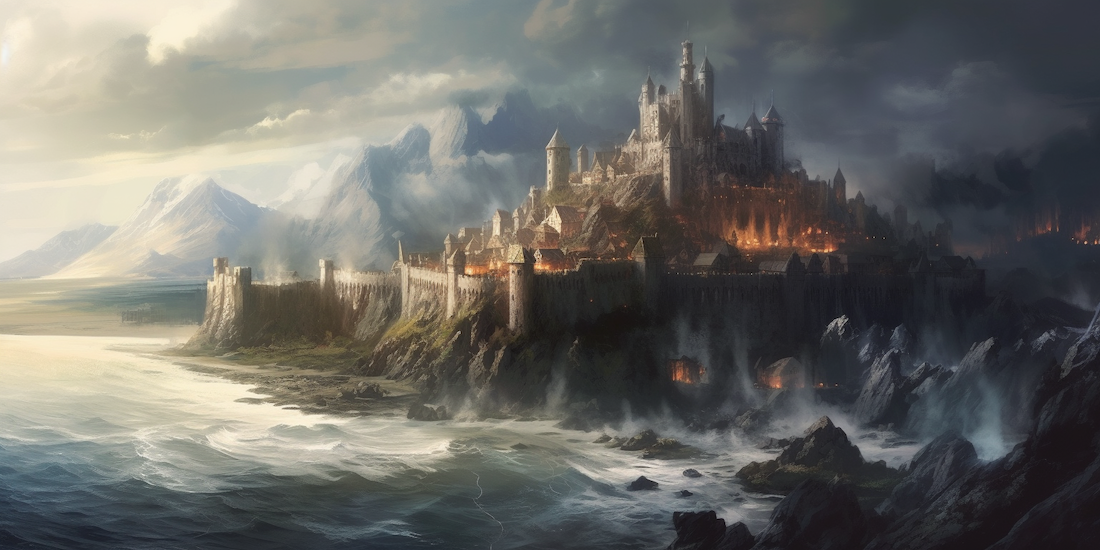
Adventurers across the Ten Queendoms know the Karya Coast as one of the most gloriously lawless outposts. The Queendoms have many betwixt-and-between areas; the boundaries between Queendoms are not rigorous, and rarely are they rigorously enforced. Moreover, many of the Queendoms themselves range from chaotic to anarchic. But only the Karya Coast lays claim to having no Queen at all.
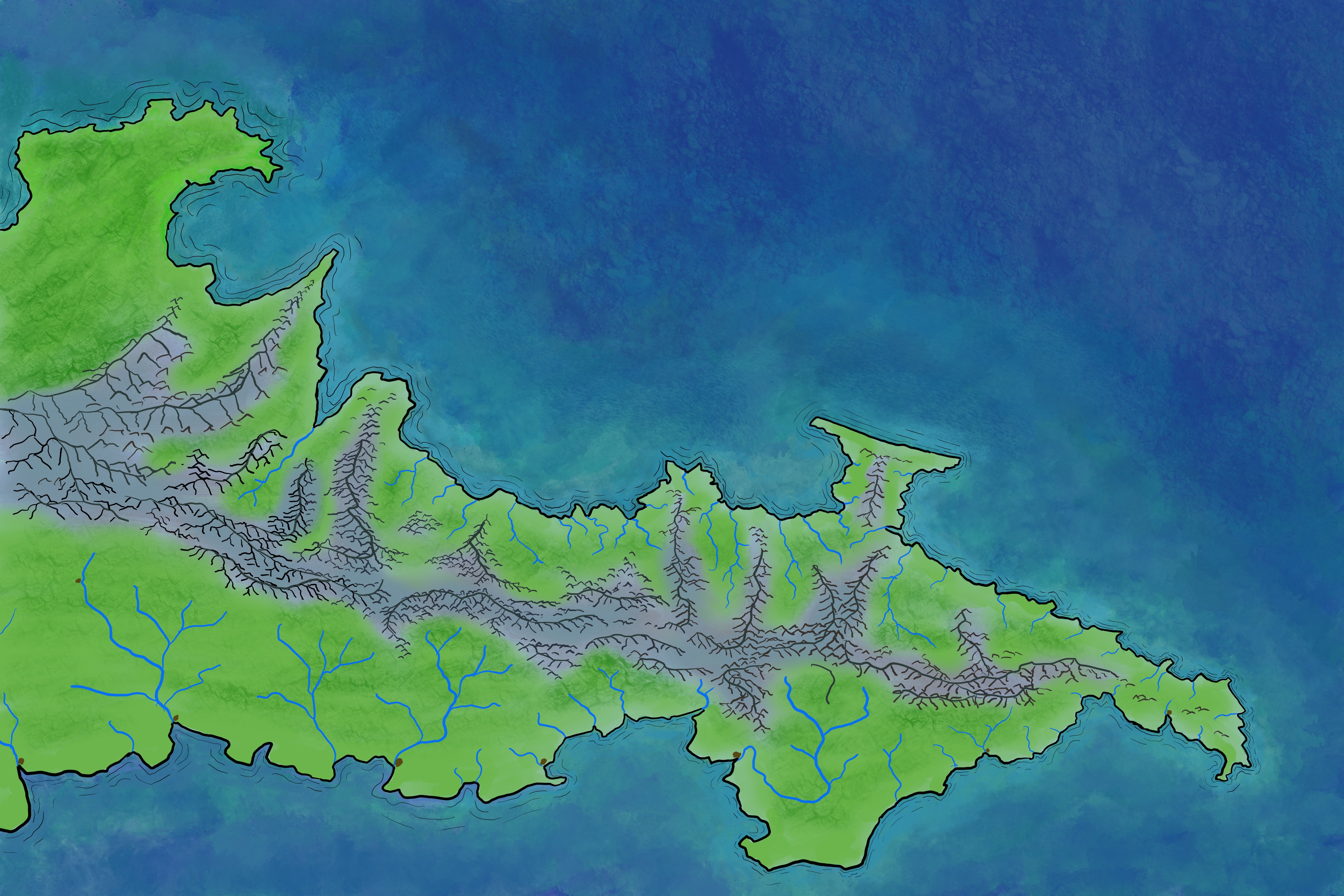 The Daarita Peninsula
On the maps of scholars (especially the scholars of Mataga), the Daarita Peninsula is unquestionably part of the Queendom of Mataga.
However, the ridge of mountains that form the spine of this peninsula are a very difficult passage in most places, and the passes are not well-maintained, while the lowland connection of the north coast has good roads into Quumla. As such the land has as much or more connection to Quumla as it does to Mataga... and yet it offers allegiance to neither.
This stretch of coast has no unified leadership, but it has very unified resistance to any sort of leadership. All efforts, by Mataga or Quumla, to subdue the coast have failed. The ruins of would-be university outposts established by Mataga, and the picked-over bones of Quumla warriors are just part of the landscape.
The Karya Coast is a land of wilderness, of ruins, of warlords, of pirate kings, of faction outposts, of exiled nobles, scandalized wizards, and stranded beings from other planes. The Karya Coast is where people go who don't want to be found, and where.
The region is often thought of as having three distinct parts: "near," "central," and "far."
The near cost is closest to Quumla, and is most influenced by trade with Quumla. It has more humans than the rest of the coast, and an architecture and style that reflects Quumla's devotion to beauty. But it is as fiercely independent and fractured as the rest of the coast.
The central coast is the most rugged, fierce, and complicated part of the coast, with the most diversity of peoples, and tangled dynamics between factions and warlords.
The far coast is marginally more influenced by Mataga. Although it considers itself part of the Karya Coast first, and Mataga a distant second, it has more of the character of Mataga than the rest of the coast: the culture of wizards dominates here, and although no official University has ever successfully reached a stable state here, every town has a school or two, usually run by a retired, fired, or scandal-tarred professor from Mataga.

Of Towns and Warlords
The cities and towns of the Karya Coast are run as highly independent city-states, each with its own form of leadership. From the smallest forest town, to the ancient edifices of cathedrals and towers, every town his its own ways. Most are highly autocratic, but there are some that experiment with other forms of governance.
Many towns have tolls on entry. These can vary from a silver or two to a gold. Locals and registered merchants may have negotiated exceptions or discounts, but the wanderer should be prepared to purchase their way into most towns.
The "Warlords" of the Karya Coast are very rarely at war with each other. The Karya Coast has long held the special role of waging it's own quiet war of deception, thievery, and piracy on the rest of the Ten Queendoms. There is little to be gained by geographical expansion within the coast itself: the towns and people have too long a history of resisting remote rulership. Whether it is Quumla, or the next town down the road, the unruly peoples of the Karya Coast are... unruly.
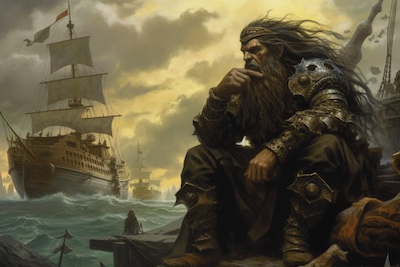
Warlords may not look the part either: as shown at right, the Ghost-Queen of Pretatva is a Warlock of unprecedented power in service to a terrifying entity; her city and surroundings are often avoided by travelers, although particularly brave merchants can make good coin by supplying her remote and isolated town.
Coin on the Coast
Gold, silver, and copper are the common coin across the Ten Queendoms; gold is typically weighed, and occasionally volume measured also. Silver and copper are generally taken at face value unless there are known problems with false currency. Larger trades are often transacted with gold bars.
The Karya coast, like all the Queendoms, accepts a "Khalri Gold" as 5gp. Khalri coins are the definition of value, and cannot (so far as anyone has discovered) be faked. but Khalri coins are rarely seen in Karya.
A local currency, minted by the great dwarven craftsman Adjazhi in Mahadasa on the Central Coast, is held in similar esteem: Adjazhi gold is only one gold, but it typically buys just a little more. It is known, trusted. The Adjazhi coin flickers with an iridescent watermark of hammer and anvil, an appearance that no illusionist has been able to convicingly duplicate.
Gems can also be currency for trade.
Ordinary gems can be negotiated in value with the help of a qualified jeweler, but this is not commonly done as it is often a poor deal for the person paying with jewels. There are also "certified" gems, gems that have been inscribed on a tiny bevel with their value. Anyone with a good magnifying glass can read the inscription, and the accompanying registry mark. There are a number of known jewelers throughout the ten queendoms whos inscription is sufficiently reputable for the gem to be used for trade. This form of payment is more common among princes and merchant captains than for any kind of day to day usage, even among adventurers. Ordinary shops will always prefer coin.
A Brief History
Although the Karya Coast has always been a land without an active and interested queen, there have been some notable historical events. These histories are only vaguely known by the residents of the Karya Coast itself. The recent memory is of the rise and fall of particular factions and towns. But the bards of Mataga working with historians have collected and preserved the stories of the coast, and there are many interesting volumes locked away in the stacks of the great libraries.
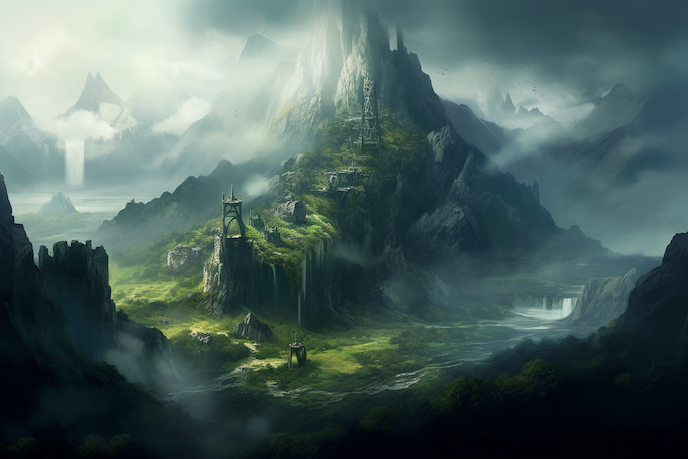
The Fall of Svanita -- in the mountains of the central coast, the Svanita Pass is one of the better roads into the heart of Mataga. But it passes through a high valley that was once a thriving part of Mataga. This high valley is now called the Valley of Whispers, and is generally shunned. The road is unmaintained, and yet it stays in remarkably good shape despite the fierce weather and general neglect. Travelers are advised to keep to the road when passing through the Valley of Whispers. What happened to this thriving valley, its several wealthy towns, and the outpost university are not generally known.
Departure of the Dwarves -- the Daarita Mountains are rich in minerals and gems, and were once the home of a great expanse of dwarven strongholds, few of which remain. There are rumors of a vast underground empire, abandoned. The various abandoned mines, ruins, and mountain strongholds are a reminder of this ancient hsitory, and are generally avoided. There are persistent rumors and stories of the "lands below" and adventurers have occasionally brought back vague stories of subterranean horrors, but no dwarven empires. Historically, it is thought that the dwarves simply relocated to Duumaba because greater wealth and the safety of a Queen's protection was a strong enticement.
The Anger of the Sea Gods -- the Ten Queendoms are ruled by Ten Goddesses, and there are no other divinities present to this world. But outside the Queendoms there is the vast, endless ocean. It is said that there are Gods of the Deep. And these gods -- or whatever they are -- are well respected throughout the coast, especially by pirates, smugglers, and fishermen. There is a persistent story, unverified by scholars, that the Karya Coast is as geologically rough as it is because there was a war waged here between the Ten Goddess and the Sea Gods.
The End of Seafaring -- The Karya Coast, as its name implies, always defined itself by it's relationship to the sea. Now... it is not even a coast, except of good land surrounded by dry and barren wastes.